
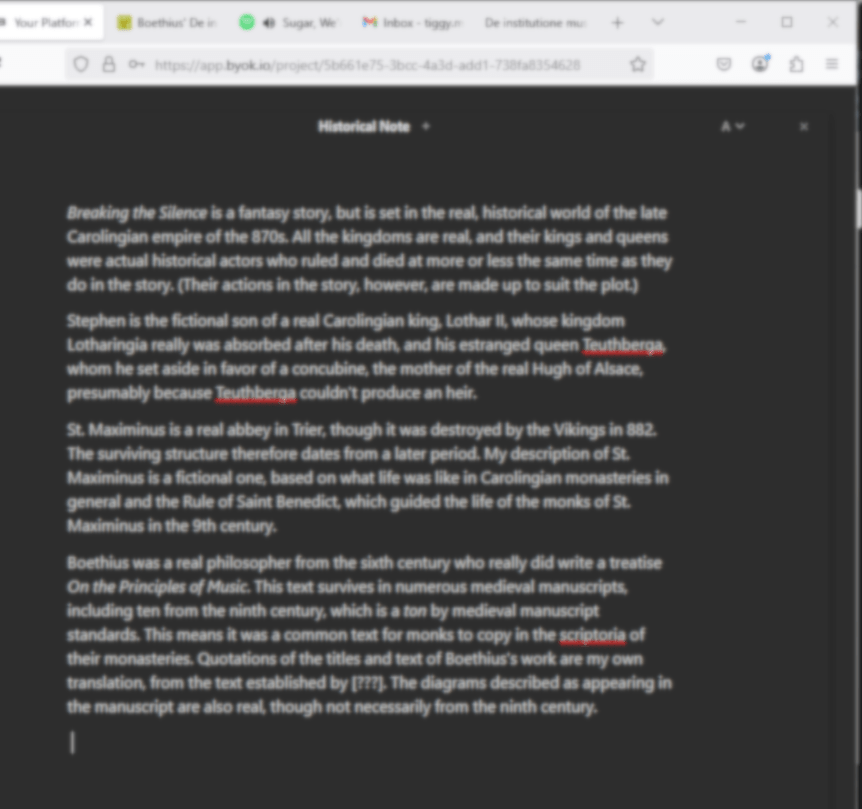
I suppose I knew all along, but never gave much thought to, the fact that once I finished a book I would have to write a whole bunch more things before I could publish it. A whole bunch more things in other genres. One of those things is the jacket blurb, which you can view over on the new page for Breaking the Silence. Another, that I’m hard at work on as we speak, is the Historical Note, a staple of historical fiction books, especially those written for kids.
I’m a historian. I have plenty of experience writing history, both for academic and popular audiences. The only things I knew about Historical Notes before I started writing this one was that the Historical Note and history are not at all the same genre, and I don’t know the first thing about writing Historical Notes. So before I could start writing mine, I had to learn what one looked like.
What is a Historical Note?
I decided to start with the school library. I’m fortunate to teach at a school that still has a functioning library, so I decided to stop there during my lunch. Unfortunately it wasn’t as helpful as I thought it would be. Historical Fiction doesn’t get its own section and instead all the HF books are lumped in with realistic and literary fiction, so I could only look at books I already knew were historical. The first book I picked up was Fever: 1793 by Laurie Halse Anderson. This book was about a specific historical event, so it makes sense that the historical material at the end was a little more than what I expected. It was a pages-long Appendix that was broken into subheadings that explained the context of several significant aspects of the plot. The next books I looked at were by Philippa Gregory. Her historical novels The Queen’s Fool and The Other Boleyn Girl were favorites of mine in high school. Her historical notes in these books were just a couple of paragraphs and a bibliography, more what I was expecting. Nothing else jumped out at me as historical except for the Nathan Hale’s Hazardous Tales graphic novels series, which feature a “what happened to everybody” section at the end similar to the appendix in Anderson’s book.
Next I checked the shelf at home. One of my favorite recent middle grade medieval books is The Inquisitor’s Tale by Adam Gidwitz, which I found at local book store two years ago. I was surprised when I opened to the back the other night to find something like twenty pages of historical background information and an annotated bibliography separated by books for kids and books for adults. I hadn’t noticed this two years ago, probably because I already knew most of the medieval background to the characters and their context and didn’t go looking for it. Meanwhile, E. L. Konigsburg’s The Second Mrs. Gioconda, a novel about the painting of the Mona Lisa, has no note whatsoever.

When I took my search to the internet (what advice do historical fiction authors give their fellow historical fiction authors about historical notes?) I found that Historical Note philosophies not only vary considerably, but are actually a point of controversy. Who knew? Specifically this blog post, in which author James Aitcheson justifies his decision not to include a historical note with his medieval novel, after including extensive appendices in his previous novels. In it he cites an article about Hilary Mantel criticizing the Historical Note as a form of authorial imposter syndrome in which historical fiction authors feel the need to establish credentials as a historian. At this point I realized there was a whole Historical Note rabbit hole I could disappear down if I let myself, and after paging through Umberto Eco’s historical considerations at the end of a later edition of The Name of the Rose in which he mostly responds to questions posed to him by readers over the decades, I stopped and returned my attention to Breaking the Silence.
Why do I need a Historical Note?
As it turns out, there is no Platonic of Form of the Historical Note that I should emulate. Instead, I should focus on crafting a Historical Note to fit the need that the Historical Note will meet for my particular book. So what does my book need a Historical Note to do?
Breaking the Silence is a historical fantasy. It is not a realistic foray into life in the late Carolingian world wherein I showcase my research on daily life in a monastery in the late ninth century, so it does not actually need a lengthy appendix with an exhaustive bibliography. As a matter of fact, while I wrote this novel I deliberately limited my research (and set the story in a time period adjacent to, but outside of, my actual area of expertise) in order to focus on the storytelling without getting bogged down by issues of historical accuracy. On the other hand, since the protagonist is fictional but I’ve set him inside a real monastery against the backdrop of real conflict among real kings, I believe it is my responsibility to disclose that information at the end of the book.
I will include a Historical Note (as I mentioned, I’m writing one now!), but I will keep it short. I will give a few bibliographical references for the interested reader who might want to learn more about the period, but I will not present an extensive bibliography. I want to be transparent about the relationship between the fictional and fantastical elements of the story and the real historical setting, but I don’t want to take attention away from the story by including a historical essay (or have the essay be totally overlooked, as I overlooked Gidwitz’s appendix to The Inquisitor’s Tale).
What I’m Reading
Can you believe it, I’m reading the same exact things I was reading last time. That’s how slow of a reader I am. Plus how busy I am. We’re coming up on the end of the school year, both for my job and for my literal children. So I’m slowly making my way through the same pile I was reading last month. Still love it, but nothing new to say about it.
What I’m Writing
Besides writing all the “extra” elements to Breaking the Silence (jacket blurb, Historical Note, etc.), I’ve been hard at work on my academic monograph about Jesus’s flesh in Merovingian Gaul. I’m actually writing the final substantive chapter of the work. I finished up a section on relics of the true cross and just started writing a section on the Eucharist as the body of Christ. Once I finish this chapter, I’ll revise the whole thing, and then I’ll be ready to propose the book to a publisher. That part is a little intimidating, since this is my first academic monograph, but I’m going to finish the draft before I even think about proposals.
 Tiggy McLaughlin
Leave a comment