
In this Breaking the Silence summer update, I muse about maps and what they can add to the experience of reading a novel. (Yes, there will be a map at the beginning of Breaking the Silence, and I’m really excited about it!)
Geography and the Novel
Geography is hard. Especially to the non-spatially inclined, figuring out where stuff is on a map in relation to each other, especially if you can’t warp to the individual locations like on video game maps, seems to take so much energy. In high school I was grateful I took French, because while the Spanish students had to take map quizzes that covered all of Latin America, the French teacher did not think we needed to memorize all the French-speaking countries. In college I somehow made it through an entire History major without knowing where anything was beyond vague regions (“Europe” or “the Middle East”). I never cared about maps in books. Not even Christopher Tolkien’s hand-drawn map of Middle Earth which, if we’re being honest, is basically necessary to following the plot of Lord of the Rings. It wasn’t until graduate school, while beginning my dissertation on preaching at the end of the Roman empire (in the west and east), that I was compelled to learn, really learn, how to read a map.
And a whole world opened up to me. Literally and figuratively. History makes so much more sense when you know where stuff is. Books with maps are richer when you actually use the map. I always knew that Breaking the Silence was going to need a map, not only since it involves travel, but especially since it is set against the political backdrop of the end of an empire, and Stephen’s story is bound up in the movements of kings.
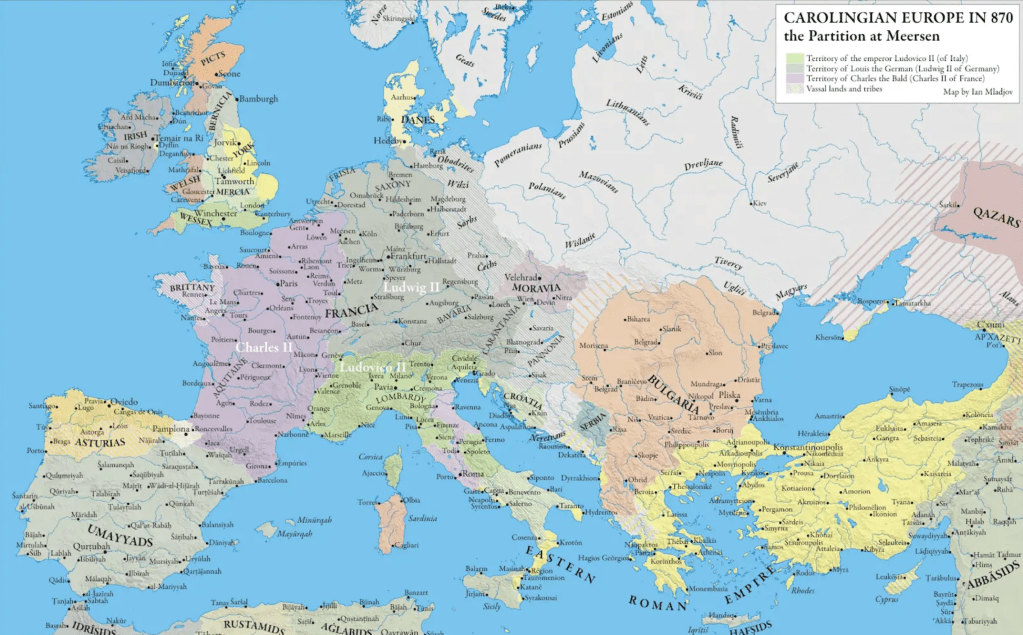
The map I’m referring to is the map of the late Carolingian empire, or Francia after the Partition of Meersen in 870. Ian Mladjov, master of online maps of premodern history, actually has two separate maps of the period: one from 870 and one from 876 after the death of Louis the German (called King Ludwig in Breaking the Silence), which is announced in the opening scene of the book. These two maps were invaluable resources to me as I wrote the book (and continue to be as I plot its sequels). I eventually made a fantasy-style map based on these maps, mostly to help me visualize the background world as I edited the novel to make sure everything made sense and lined up.
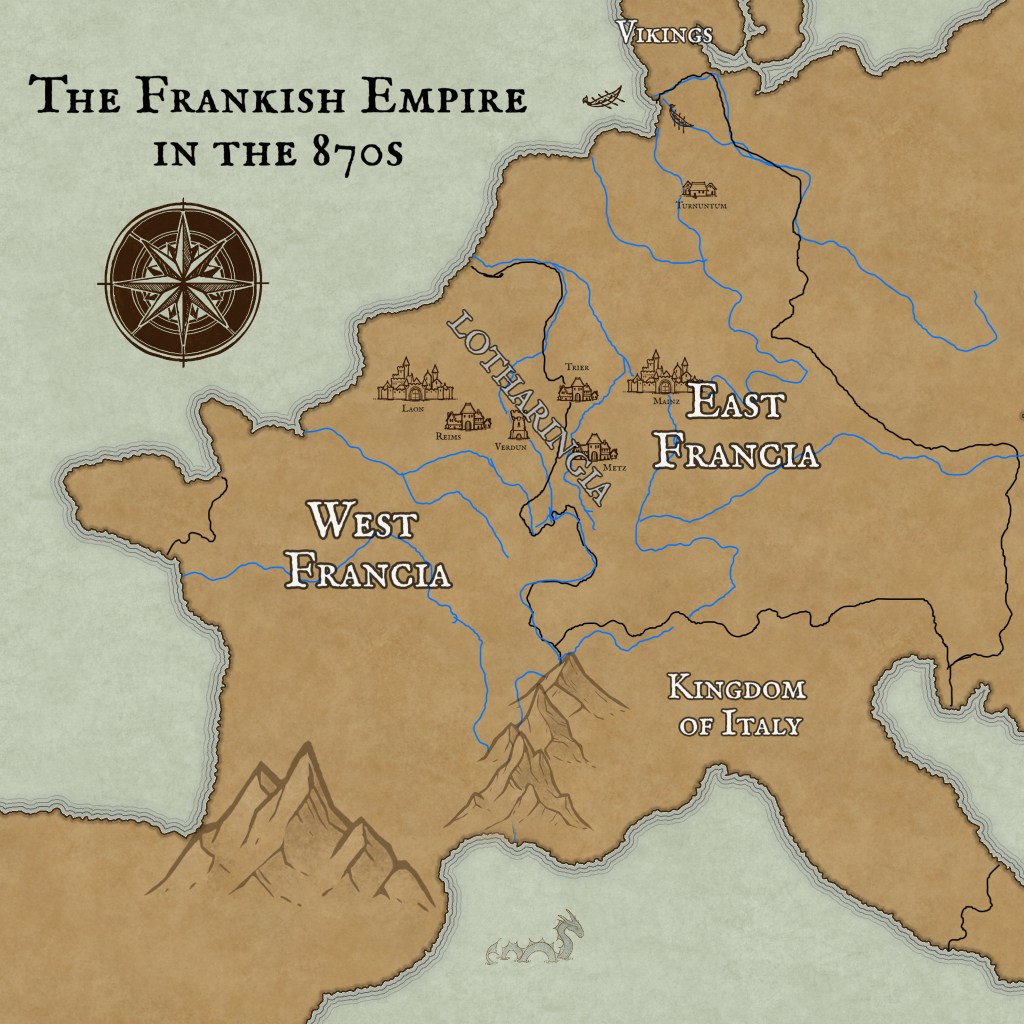
Now, I am delighted to report that Ian himself has been commissioned to make the map for Breaking the Silence. It will be a line drawing map, similar to those found in Lord of the Rings and other fantasy books in the same vein, but made with the historical precision and accuracy of Ian’s historical maps. I can’t wait to see how it turns out!
What I’m Reading
My main summer read right now is Wintersmith by Terry Pratchett. I never read any of the Discworld series before, but I found this on the cart of books the school librarian was giving away after decommissioning them from the library and thought it looked fun. It is. I also like that it’s about witches. I think I’ll check out the other Tiffany Aching books when I finish it.
I’m also rereading the Amulet series by Kazu Kibuishi. Mostly, I love these books. The art is amazing, the world is immersive, characters are cute, and the story was great for the first six books. I think it loses the plot in Book 7 (but don’t let that deter you from reading them if you haven’t), and I didn’t really care for Book 8. So much so that I never actually got the conclusion, Book 9, until earlier this year. I’ve been rereading the series in anticipation of finishing (I’m on 7 again). Meanwhile during my reread, my two older kids, ages 10 and 7, decided to binge read the series. They also loved the series (and even play Stonekeeper sometimes), and were dissatisfied with the ending. I told them not to spoiler it for me, but they both, independently of one another, said they didn’t really like it and it didn’t really make sense. Oh well. I’m still going to finish it.

Last, I’m reading Harry Potter e il prigioniero di Azkaban (yes that’s Harry Potter and the Prisoner of Azkaban in Italian), which my spouse bought me last time he was in Italy. It’s one of my favorite books of all time, my favorite in the HP series, and if you haven’t already tried it, reading a familiar story in a different language is a great way to practice reading that language. I can pretty much guess at all the vocabulary I don’t know because I know the story so well. What’s really fun about this book, though, is the map. I don’t know if it’s in any English language version of the story (I only have the original US publication of the HP books), but this is the first I’ve seen it, and it really helps me put into perspective where everything is located around Hogwarts. (Even after 25 years of reading the books and a play through Hogwarts Legacy…)
What I’m Writing
I’m focused on my academic writing this summer as I work on publishing Breaking the Silence. I just finished a draft of the last substantive chapter of the monograph I’ve been working on for the past five years, and that was a huge milestone. The book is far from finished, but I know what I’m saying, and that is really exciting. Since then, I’ve been working on an article about the sixth-century preacher and bishop Caesarius of Arles for an edited volume on Caesarius’s preaching. After I finish writing that I’ll get back to revising the chapters of the book.
 Tiggy McLaughlin
Leave a comment