
Or anything, really
If you’re reading this, it’s probably because you’ve tried everything. Or you want to try something new. Or you find yourself getting distracted while writing and are curious about things you might try. This post is not so much advice for the distracted as a product review. But it is an honest review, one that I’m not being paid to write, or receiving any other form of compensation. I don’t even have affiliate links. I just backed the BYOK on Kickstarter, received my product, and want to write a little bit about what I think.
What Is a BYOK?
BYOK, which stands for “Bring Your Own Keyboard,” is a compact device, similar in size and weight to an average smartphone, that connects to your favorite keyboard via Bluetooth or USB-C, allowing you to write without the distractions offered by other devices that do more than just word process.
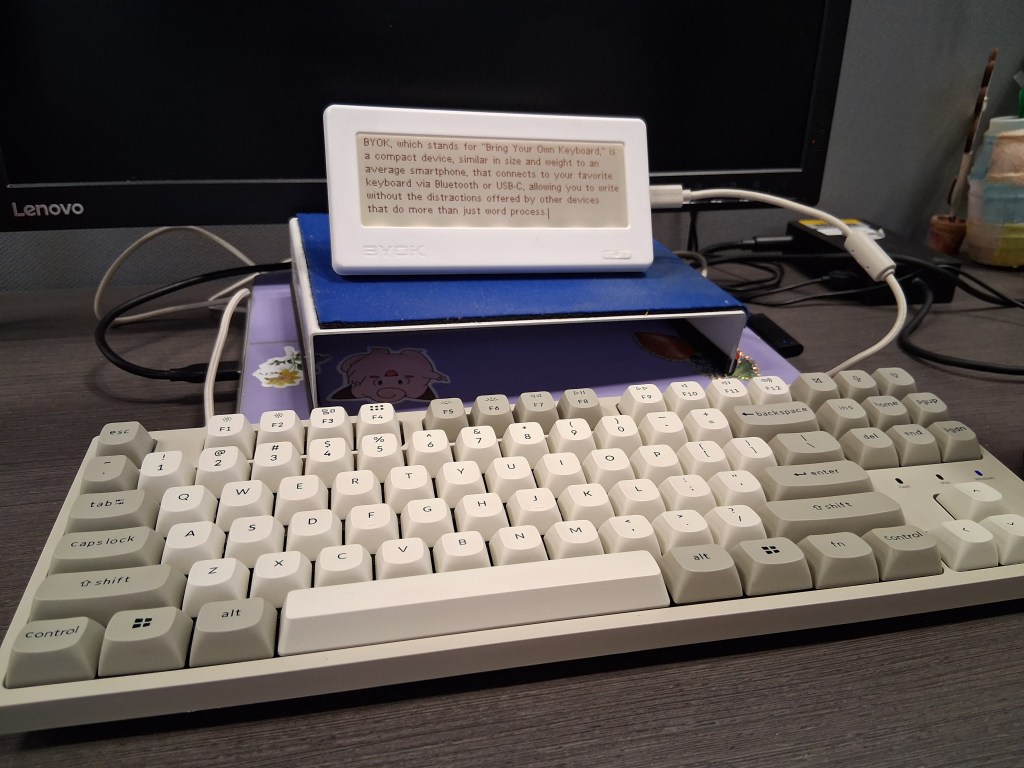
I am pleased to report that it works exactly as intended, right out of the box. The LCD display is clear and keeps getting better, the various brightness levels of the warm backlight (shown at the brightness level 2 setting) allow for visibility in a variety of different environments. (Including outside. I am most looking forward to taking this thing outside, when there isn’t any more snow on the ground.) I have not had a chance yet to test out the full life of the battery, but I have used the device for several days so far with a USB keyboard and the battery is still at 60%. Finally, syncing via USB also works as expected. The device has a setting called “disk mode,” that when enabled allows you to plug it into a computer and transfer the .txt files to edit on a more sophisticated program.
The BYOK device also pairs with an app called Studio (that exists in both free and paid versions) for wireless syncing. The developers claim that the syncing option will always be available at the free tier, but it is not necessary to use the app at all to use the device. I have used (and like) the Studio app, but I have not tried the syncing feature yet. Perhaps, someday in the future, I may decide to write a review of Studio as well, but I will limit my thoughts in this post to the device.
How I Plan to Use the BYOK
I admit, the concept of “bring your own keyboard” intrigued me from the first time I saw the Kickstarter advertised in online writing circles. But it’s not because I have a favorite keyboard. (In fact, I had the BYOK device in hand before I actually decided to buy a nice keyboard.) It was because I write all over the place. I trained myself years ago to write in spare moments of free time. Being a full-time teacher and parent, these moments really are spare, and they aren’t always in ideal settings. I wanted a BYOK so I could bring my draft from room to room, keyboard to keyboard, work to home, and keep the writing momentum going wherever I am. The keyboards stay where they’re at (in my classroom, in my office — that’s where the nice one is –, and on my desk at home), and the BYOK travels with me.
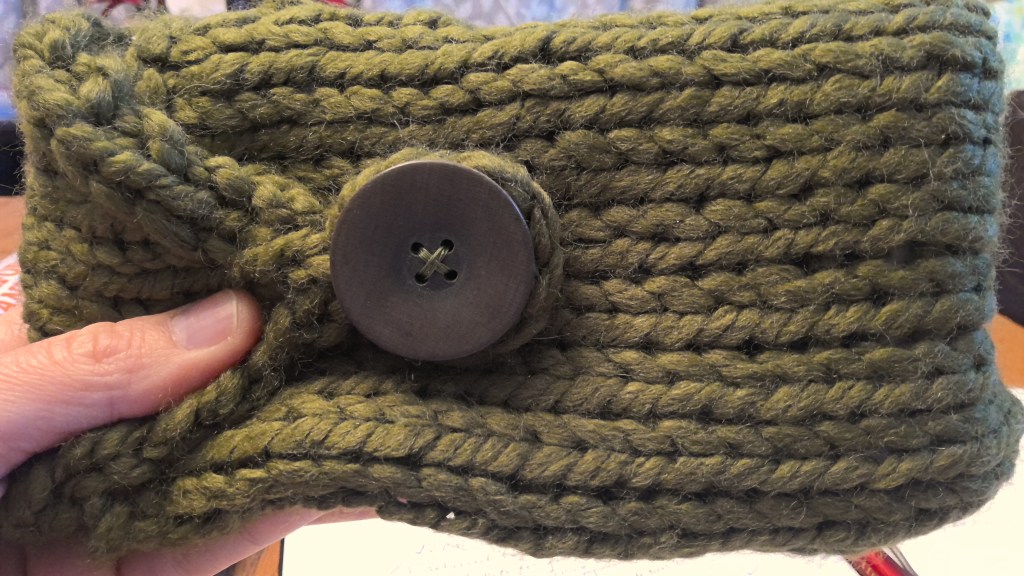
The first thing I realized I needed was not a portable keyboard, but rather a case. The BYOK comes in black or an off-white color, and I went for the off-white. Possibly a mistake, given my affinity for lipstick and carrying the thing around with me in a tote bag, but one that I will have to live with. So I asked a friend who knits to knit me a little sleeve for it, and the result is adorable. There’s also enough room for the USB cord and USB adapter (for when I plug a USB-A keyboard into the BYOK). The same friend had knitted me a case for my fourth-generation iPod back in 2005, so I asked her to do the same for my BYOK. It’s doing a great job keeping it safe in the tote bag!
Although the BYOK website shows the device paired with all manner of portable, foldable, compact keyboards, I am not interested in getting a portable keyboard, at least not yet. I’m happy bringing my BYOK from keyboard to keyboard, work to home, and back to work. But there will come a time that I will want to write somewhere else. (Like outside.) I’m glad that the BYOK has the versatility to do that, and maybe one day I will invest in a portable keyboard (and ask my friend to knit a new case to go with it). Right now, when I want to write somewhere other than my classroom, office, or desk at home, I have a cheap USB keyboard that came with an old desktop once upon a time that weighs next to nothing, and I bring that with me to other writing sites.
The Test Run
I’m not drafting a new story right now (the shiny first draft I finished a few months ago is still gestating), so it was a couple weeks before I really got to test out the BYOK. That chance came last week when I needed to draft a proposal for my academic book during some class periods while my students attended a presentation by a guest speaker in the auditorium. I attended the presentation with them, and during the last two periods of the day (times four and five for me listening to the same presentation), I brought the BYOK to the audi along with the cheap, lightweight keyboard I had in the closet of my classroom.
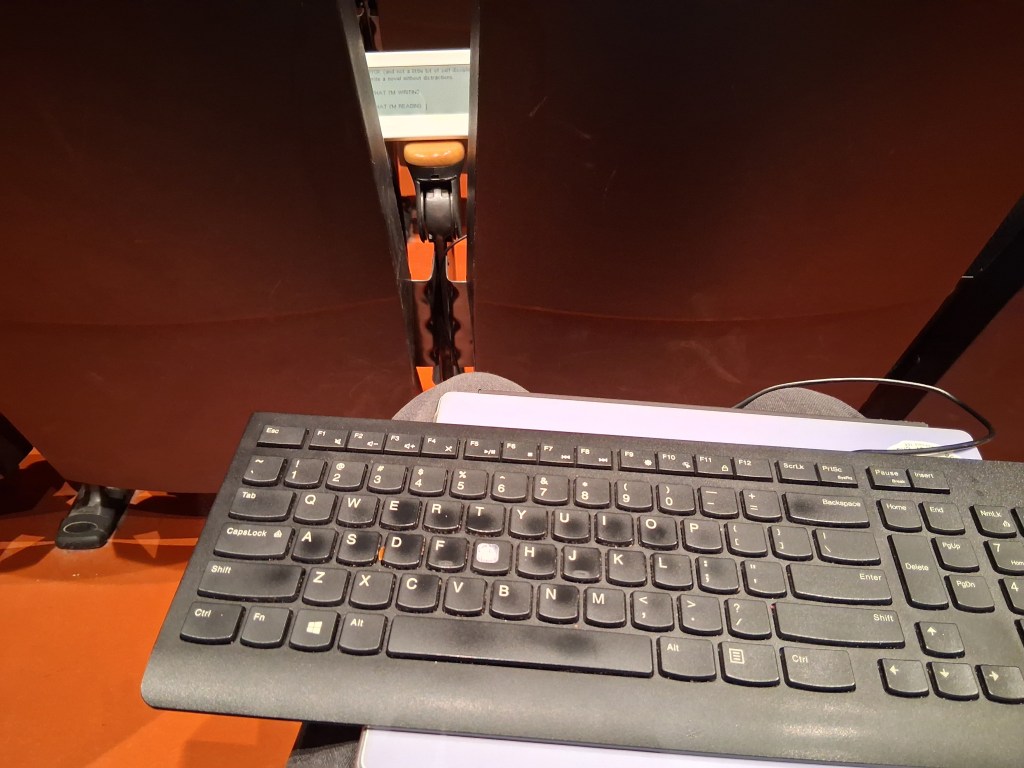
The set up is pretty rudimentary, but it worked. With my laptop closed, I was not distracted by emails, chats, research, school-related work, and any of the countless other things I could have been doing during this presentation. All I could do was draft the proposal. And guess what? I finished it. I wrote an entire draft of a proposal on the BYOK during two class periods’ worth of guest speaker without being distracted by any other work or fun.
And guess what else? I finished the proposal even though a fire drill occurred during the middle of eighth period and I had to leave my BYOK and keyboard in the seats as I evacuated the building with the students. When I returned to my seat in the auditorium at the beginning of 9th period, I found that the backlight on the BYOK had turned off after some minutes of inactivity (it turned back on when I started typing again), and without even opening my laptop back up, I sat down and finished my proposal draft during the final presentation. The test run was successful.
I also wrote this post on the BYOK during my prep period in school one day. I closed my laptop and sat the BYOK on top of it. For thirty solid minutes, I did not see an email or a notification. If I thought of something I needed to do, I did not immediately hit the tab next to the one I was working in and take care of it right away. Eventually, those thoughts stopped coming, and I was able to focus on drafting this review. In its entirety. In thirty minutes. So I have to say the device works, at least for now. With a BYOK (and not a little bit of self-discipline), you can write a novel without distractions.
Conclusions
Are there shortcomings? Of course there are. Nothing is perfect. The color, I already mentioned, is pretty easily susceptible to scratches and discoloration. I probably should have ordered the black. But to be honest I’m really enjoying this ’90s tech aesthetic that’s in fashion right now, and I like that it matches my retro keyboard.
Also the LCD display is… an LCD display. The words do not come up on the screen as fast as I type them, which isn’t anywhere near as fast as I’m thinking. This can be frustrating when I’m getting ideas as I’m drafting. But the BYOK does not claim to be anything other than an LCD display that lets you type.
Its shortcoming is its virtue. It works exactly as it claims to, exactly as expected, and so far it has done what it promises to do, which is to allow me to write without distractions. I recommend this product.
What I’m Writing
I continue to focus on my academic writing as I have been for the last couple of months. I am most of the way through revising the chapters of God in the Flesh and I’m working on a proposal to submit that book for publication. I’m also revising a conference paper I gave last year at Shifting Frontiers in Late Antiquity, on the motherhood of the virgin Mary in the sixth century, into an article for the book that will emerge from that conference. Both of these revisions have required some additional research, so I’ve been reading a lot as well as writing some more developed explanations for things to strengthen the argument for both pieces.
What I’m Reading
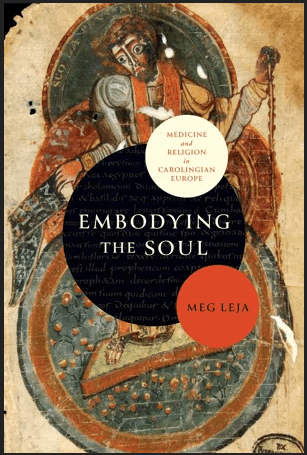

Much of my reading has been for research. I’m currently reading Embodying the Soul by Meg Leja, which I originally found for my Mary article, but it turns out that it will be more helpful for framing my book on sixth-century perceptions of the flesh of Christ. One intervention of this book is to show how Carolingian religious interest in medicine reflected a growing appreciation of the body as equal to, and not less than, the soul. I am also re-reading Stephen Shoemaker’s excellent book on the early veneration of Mary Mary in Early Christian Faith and Devotion for the Mary article, as well as Virgin in Song by Thomas Arentzen on the hymns of Romanos the Melodist, which I consider in my Mary article.
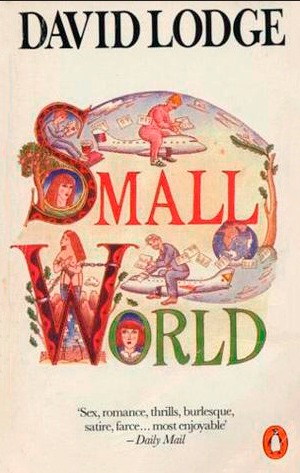
For fun, I’m reading Small World by David Lodge, and despite the literary writing style, it is a very fun read. The subtitle is “An Academic Romance,” and the result is an allusion-filled grail quest set amid the travels of academic conference-goers. An old professor recommended it to me years ago when I was writing my Kalamazoo novel and I never got around to reading it until now. I’m glad I am, though. It’s an old book, from the 1980s, and although the culture of academic conferences has changed significantly over the past 40 years, there is still plenty that’s relatable, and therefore funny.
One aspect of the book that has renewed cultural relevance for the present day is a depressed character “discussing his research” with a primitive AI chatbot in the university “computer center” that’s programmed to ask followup questions in the manner of dialectical talk therapy. I haven’t finished the book yet so I don’t know exactly what will happen to this character, but I have an idea where this subplot could be headed, and I can only respond with the grimace emoji… 😬
One Final Bit of News
I finally have an update on the publication timeline of Breaking the Silence! Two bits of news are relevant here:
1. IT HAS A COVER! And I will reveal it on the website and social media in the coming weeks.
2. Proofs should be ready by the end of the month. Then the book will be published shortly thereafter. Be sure to follow and subscribe for information on when you can order your copy!


Leave a Reply